


The Future of Signage: Trends, Business Impact, and Event Significance
6 maggio 2026
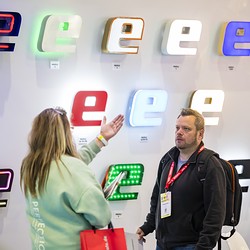
Ahead of European Sign Expo 2026, Nita Odedra, Director of Strategy, Blue Rhine Industries and speaker at The FESPA Conference, shares her thoughts on how the signage industry will look in the future.
The signage industry is experiencing a period of change, where its role within the built environment is being reevaluated. Once a tool for applications such as wayfinding and promotion, signage is now increasingly positioned as part of a broader communications and experience strategy, closely tied to brand identity and data use.
This shift is driven by emerging pressures: advancements in technology, stricter requirements around sustainability, and the demand for more responsive communications in public and commercial spaces.
As a result, it is important to consider how signage affects how spaces operate and how audiences interact with them.
Trends
Signage is more integrated and interactive than ever before. Digital displays are increasingly layered with sound, lighting and – in some cases – even scent, to shape how people experience the space around them. This means that signage today is more immersive than traditional screens alone.
At the same time, sustainability is now a standard expectation. With advances in solar-powered solutions, signage must not only be environmentally responsible, but commercially viable too. As a contributor to business growth, signage and wayfinding must be considered as a long-term investment that can reduce operational costs, as well as carbon impact.
In addition, digital displays enable dynamic, real-time content updates, significantly reducing the need for frequent reprints and associated waste. This not only lowers material and distribution costs, but also allows businesses to respond quickly to changing information, promotions or user needs.
There is also more of an expectation for personalisation, and technologies are advanced enough to support experience-led applications. For example, in retail, facial recognition technology is able to identify key demographics and supports the delivery of relevant content, while enabling seamless payments without having to queue at checkout.
Ultimately, signage is no longer a standalone element. It is increasingly valued as part of a connected ecosystem and integrated with audio visual (AV) and other smart technologies from the earliest stages of a project, rather than added as an afterthought.
Impact on the future of the signage industry
The integration of seamless, personalised, and digital experiences is expected in physical environments too.
As a result, signage is more responsive and connected, and hyper-personalisation relies on real-time data. For example: who is in a space, how do they move through it, and what content is most relevant at that moment?
Businesses frequently look for solutions that enable this in live environments, including events, theatres, stadiums, and hospitality spaces. The focus is on experience, where people are not just seen as visitors but active participants in a space.
This is already visible in everyday interactions, where signage adapts in real time to create frictionless journeys. In shopping centres, for example, smart parking systems recognise vehicles automatically, allowing efficient entry and exit.
More broadly, digital signage gives businesses greater control and agility. This enables messaging to shift instantly in response to operational needs, updates or targeted brand communications.
Business Impact
For businesses in the field, signage can no longer be treated as a standalone layer. It needs to be considered early and integrated with audio-visual, digital systems, and the wider built environment.
Hardware alone isn’t enough; the combination of the right software and hardware makes signage truly responsive and future-proof. Together, they shape how public spaces function in real time. When implemented correctly, signage becomes the layer that connects people to a space by helping them move confidently, reduces friction such as crowding, and ensures information reaches the target audience quickly.
When creating truly usable spaces, the industry also has a responsibility to design for inclusivity by creating environments that are accessible and intuitive for people of determination.
It’s equally important to align with wider policy and city priorities, as governments begin to introduce frameworks that directly affect signage and lighting. For example, Dark Sky Policy initiatives, such as those in Abu Dhabi, aim to reduce regional light pollution and energy waste. Businesses that design in-line with these policies are better positioned to contribute meaningfully to the public realm.
Beyond this, staying close to the industry matters. Sharing insights from real case studies, participating in discussions, and keeping pace with how technology is being applied in practice all help businesses to stay relevant.
European Sign Expo
European Sign Expo unites the signage and print communities and helps them to create space for genuine knowledge exchange – be it trends, technologies, or beyond. It provides a platform for visibility, helping signage companies to build credibility and clearly communicate their unique business offering.
The event also spotlights thought leadership via sessions at The FESPA Conference. From speaker and panel sessions to networking, the exchange of industry-specific expertise helps others to understand your value and how it can support their business’ success.
Ultimately, it’s about being part of the conversation. The companies that engage and contribute are those that are helping shape where the industry goes next.
FESPA invites you to join Nita, as well as a host of experts at European Sign Expo, to learn more about what the future holds for the signage industry. For more information, and to register, click here.




Sfoglia le Riviste





Follow us



© Copyright 2026. PrintPUB.net - N.ro Iscrizione ROC 35480 - Privacy policy